

Building AI-Powered Customer Service That Works Around the Clock in 2026
In short
Building an AI-powered customer service that works around the clock in 2026: what it can handle, what it should escalate, and how to deploy it without losing the human touch.
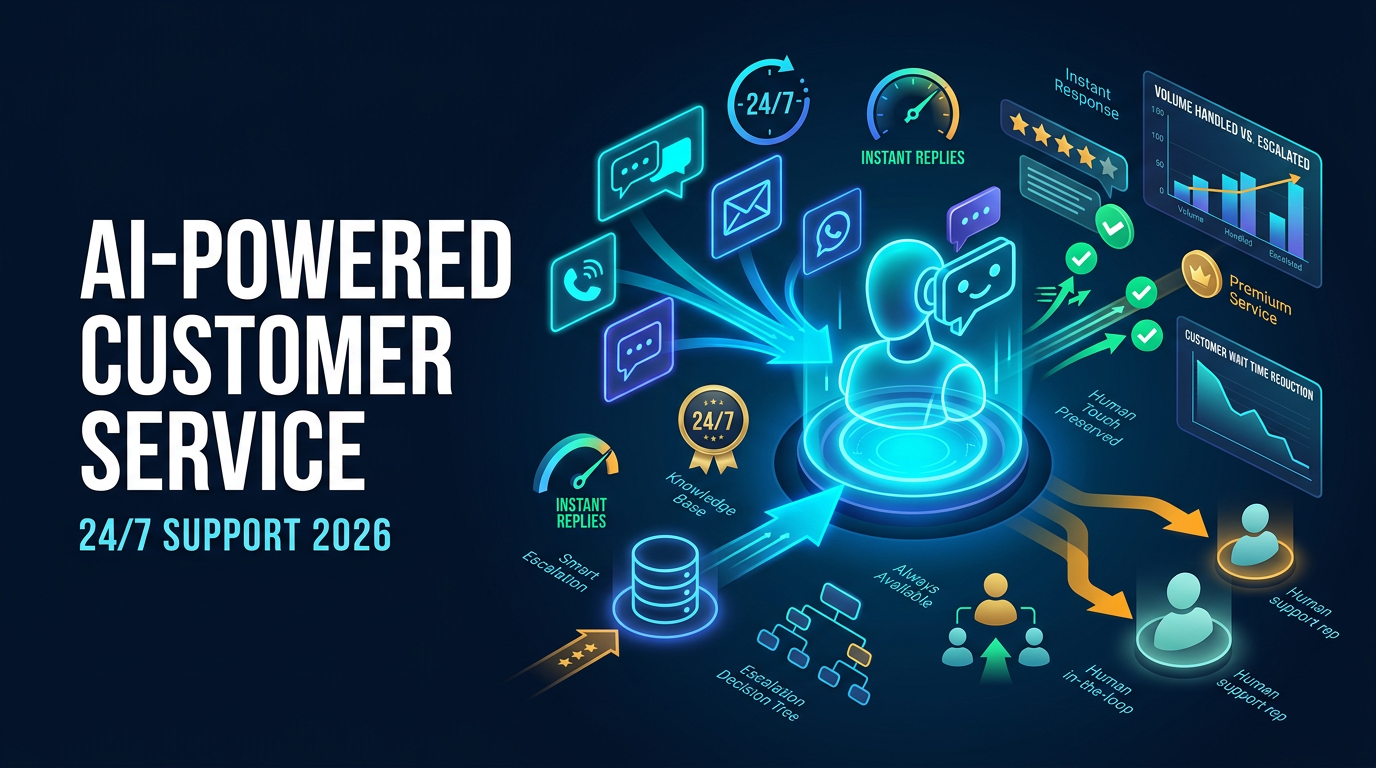
Customers expect fast answers, increasingly at any hour. For most businesses, staffing support around the clock is unrealistic, and slow responses cost sales and goodwill. AI-powered customer service closes that gap, handling the bulk of inquiries instantly while leaving the human-worthy cases for humans. This article explains how to build it well in 2026, and how to avoid the version that frustrates customers.
This builds on our guide to AI agents for business, applied specifically to support.
Table of Contents
- Why support is the natural starting point
- What AI handles well
- What should always reach a human
- The hand-off that makes or breaks it
- How to deploy it sensibly
- Measuring whether it works
- Conclusion
Why support is the natural starting point
Customer service is often the best first place to apply AI, because so much of it is repetitive. A large share of inquiries are variations of the same handful of questions: order status, returns, hours, basic how-tos. Answering these consumes enormous staff time while requiring little judgment, which is exactly the profile where AI delivers the most value for the least risk.
Handling that repetitive volume automatically frees your team for the conversations that genuinely need a person, and it gives customers instant answers at any hour.
What AI handles well
AI is strong at the high-volume, well-understood questions. Order and shipping status, return and refund basics, store information, common product questions, and routing a request to the right department are all squarely in its wheelhouse. For these, a well-built system answers instantly and accurately, drawing on your existing information.
It can also handle the first step of more complex cases, gathering details, identifying the issue, and preparing everything so that when a human does step in, they have the full picture and can resolve it faster.
What should always reach a human
Just as important is knowing what AI should not handle alone. Emotionally charged complaints, sensitive account or billing disputes, anything involving a frustrated customer, and unusual cases that fall outside the known patterns all deserve a human. Pushing these onto AI is where customer service automation earns its bad reputation.
The principle is simple: let AI handle volume, let humans handle judgment and emotion. A system that knows its limits and escalates gracefully is far better than one that tries to do everything and fails the cases that matter most.
Tip: Design the escalation path before the automation. The question is not just “what can AI answer” but “how cleanly does it hand off when it cannot.” A smooth hand-off is what separates helpful AI support from the kind customers hate.
The hand-off that makes or breaks it
The single biggest difference between good and bad AI customer service is the hand-off. When the AI reaches its limit, the customer should move to a human smoothly, with the full context carried over. No repeating themselves, no dead ends, no being trapped in a loop with a bot that cannot help.
Done right, the customer barely notices the transition. Done wrong, they feel stonewalled, and that single experience can cost the relationship. Investing in a clean escalation is not optional. It is the core of the whole system.
How to deploy it sensibly
The sensible path mirrors any good automation rollout. Start with a defined set of common inquiries, the ones you can answer confidently and safely. Keep a clear, easy route to a human at every point. Launch in a limited way, monitor real conversations closely, and expand the scope only as the system proves reliable.
Resist the temptation to switch everything over at once. A narrow, well-tested deployment that customers actually like beats an ambitious one that generates complaints.
Measuring whether it works
Track a few honest metrics. Response time and resolution rate show efficiency. The escalation rate shows whether the AI is handling what it should. And customer satisfaction shows whether any of it is actually helping, because faster answers that annoy people are not a win. If satisfaction holds or improves while response times drop, the system is working.
Conclusion
AI-powered customer service, built well, gives customers instant answers around the clock and frees your team for the conversations that need them. The keys are knowing what to automate, knowing what to escalate, and getting the hand-off to a human right. Get those three things right and it strengthens the customer relationship rather than straining it.
If you want help building AI customer service that customers actually appreciate, talk to us. We design support systems that handle the volume while keeping the human touch where it counts.
Related articles
AI Agents for Business in 2026: What They Actually Do and Where to Start
AI agents for business in 2026: what they actually do, how they differ from ordinary automation, where to start, and how to avoid the common mistakes that waste money.
AI Agents vs. Automation in 2026: Which One Does Your Business Actually Need?
AI agents vs. automation in 2026: the real difference, when each one is the right choice, and how to avoid paying for an AI agent when simple automation would do the job.
7 AI Automation Workflows Every Small Business Should Consider in 2026
Seven practical AI automation workflows every small business should consider in 2026, from inbox triage to lead follow-up, and how tools like n8n tie them together.