

AI for Amazon Sellers in 2026: Scaling Without Breaking the New Rules
In short
AI for Amazon sellers in 2026: how to scale listings, keywords, and PPC with AI, stay within Amazon's new automation rules, and where a tool like Helium 10 fits in.

Selling on Amazon at any real scale means more listings, more keywords, and more ad spend than anyone can manage by hand. AI is the obvious answer, and in 2026 it is genuinely powerful. But there is a catch many sellers miss: Amazon changed its rules for how AI tools and automation may operate on the marketplace. This article covers both, how to scale with AI, and how to do it without putting your account at risk.
This is part of our e-commerce series, building on the broader overview in AI for e-commerce, focused specifically on Amazon.
Table of Contents
- Why manual work stops scaling
- Amazon’s new AI rules (and why they matter)
- Where AI helps most
- Helium 10 in a compliant setup
- A practical weekly workflow
- Mistakes that get expensive
- Conclusion
Why manual work stops scaling
With a handful of products, you can do everything by hand. Somewhere past a dozen or two SKUs, that breaks. Keywords get missed because there is no time to check every listing against current search data. Bids drift for days unnoticed. Inventory slips out of sync. Competitors who automate pull ahead on both visibility and margin.
This is not a discipline problem, it is a volume problem. Past a certain point, manual optimization is simply not feasible without either quality slipping or hours exploding. That is where AI moves from nice-to-have to necessity.
Amazon’s new AI rules (and why they matter)
Before reaching for tools, one thing many sellers overlook: Amazon updated its policies to explicitly govern AI-driven automation on seller accounts. The core ideas are straightforward. Automated actions must run through Amazon’s official API rather than browser automation or scraping. Activity must be attributable to a registered developer. And high-impact actions, large bulk changes or big price swings, require a human approval step rather than fully autonomous execution.
The practical takeaway is that your tool choice is now also a compliance choice. Tools that work through official channels keep you safe. Tools relying on scraping or unofficial workarounds are a growing risk. Enforcement has tightened, so this is worth checking on whatever you already use. Rules evolve, so verify the current specifics against Amazon’s official terms.
Where AI helps most
With the rules in mind, the highest-value uses become clear. Keyword research is the most obvious: instead of manually gathering search terms, AI delivers a prioritized list by volume and competition in minutes. For listings, AI drafts titles, bullets, and descriptions with the right keywords built in, which you then review and approve, fitting neatly with the human-approval principle. In advertising, AI analyzes campaigns, suggests bid changes, and surfaces negative keywords wasting budget. And in inventory, automation keeps reorder points and stock accurate.
The pattern throughout: AI prepares and proposes, the human approves anything with weight. That approach is both efficient and the safest path through the new rules.
Helium 10 in a compliant setup
For an established tool that works through Amazon’s official API and covers the core seller tasks, many sellers use Helium 10. It combines keyword research, AI-assisted listing creation, and PPC management in one place, which saves jumping between separate tools.
What matters more than the tool is how you use it. In a compliant setup, you let the AI handle drafts and analysis, review the suggestions, and deliberately approve bulk actions rather than letting everything run unchecked. Keep price automation within sensible limits and rely on official data sources. That keeps the setup on the safe side as enforcement tightens.
Tip: Before activating any automation tool, check three things: does it work through Amazon’s official API, does it keep an action log, and is there a human approval step for big actions? If all three are yes, you are on solid ground in 2026.
A practical weekly workflow
Here is a routine that works in practice, often about an hour a week for a mid-sized catalog. Start with the data: which listings lost visibility, which campaigns are drifting? Let AI do the first analysis so you focus on the few real issues. Then handle keyword and listing updates for the weakest products, with AI drafting and you approving. Next, review the PPC suggestions and apply the sensible bid changes and negative keywords. Finish with a quick look at inventory and reorder points.
The goal is not to do everything in an hour but to structure the work so AI gathers and prepares while you step in only where judgment is needed.
Mistakes that get expensive
The most common mistake is not bad intent but ignorance of the rule changes, running tools set up years ago that may no longer be compliant, especially anything using scraping or browser automation. A second is overly aggressive price automation. A third is fully automated bulk listing changes with no approval step. And a quiet one: keeping no action log, which leaves you exposed if Amazon ever asks for proof.
The fix is unglamorous but effective: once a quarter, audit every automation tool, check that it runs through the official API, where its data comes from, and whether it logs actions. That fifteen minutes can save an account.
Conclusion
AI is no longer optional for scaling on Amazon, but in 2026 it comes with guardrails. Automation is welcome, through official channels, with logging, and with human approval on the big moves. Get that right and a tool like Helium 10 lets you automate far more than before while sleeping soundly. The question is not whether to use AI, but how: let the machine prepare and propose, and keep a human deciding anything that matters.
If you want help building a compliant, AI-assisted Amazon setup, talk to us. We design workflows that scale and stay on the safe side.
Related articles

AI for E-Commerce in 2026: Where It Actually Helps and How to Start
AI for e-commerce in 2026: a practical overview of where AI genuinely helps online stores, from product discovery to operations, and how to adopt it without chasing every trend.
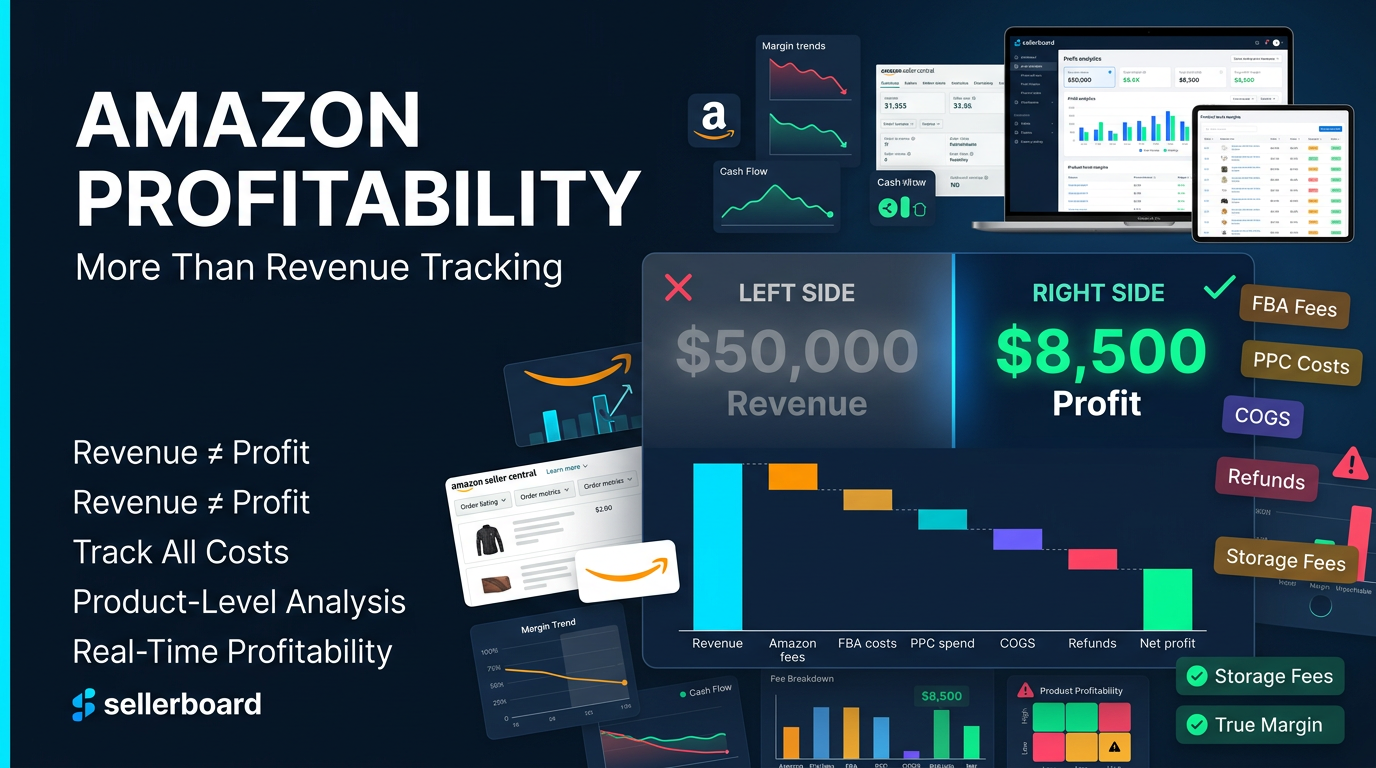
Amazon Profitability in 2026: Why Revenue Tracking Is No Longer Enough
Why revenue tracking is no longer enough for Amazon sellers in 2026, and how true profit analysis with tools like sellerboard helps you protect your margin.

AI Product Research for E-Commerce in 2026: From Idea to Listing
AI product research for e-commerce in 2026: how to go from idea to validated product to ready listing faster, where AI genuinely helps, and where human judgment still wins.